IF ITS GOT WHEELS AND AN ENGINE, IT'S HERE

Monday, 13 August 2012

2WD For Motorbikes; Has the Dream come true?


No matter how sophisticated motorcycles get, there is always some bright spark working on something new and amazing. The best of it all is that it’s not only the major manufacturers who are doing the inventing; often it is small companies beavering away on some pretty significant stuff that could change the face of motorcycling.
The Christini Frame
Probably the most significant problem that has fascinated engineers is the issue of 2-wheel drive for bikes. As with 4WD systems for cars, the benefits are obvious but the engineering is vastly more difficult because of the layout of a motorcycle or, more specifically, the situation of the front wheel, which has no obvious direct path along which to transmit the power.
Drive to the headstock
Yamaha and Ohlins have been working (and spending) hard on a system that uses a hydraulic motor to drive the front wheel (called the 2-Trac) and KTM has patented a system that uses an electric motor in the front hub but there is nothing to suggest that we will be seeing these systems on a production bike any time soon.
Similarly, a look at patent applications shows that many of the major manufacturers have been working on 2WD research and development, but have just kept very quiet about it. Quite why, it is hard to understand as the improvements in traction, handling and safety under low-grip conditions have to be the holy grail of any wheeled vehicle design.
However, the veil of secrecy only extends to road bike development. For off-road applications, the manufacturers have been much more open and possibly the only reason that things haven’t progressed further is that major sanctioning bodies for motorcycle sport have banned 2WD from motocross and enduro events. And that can be for only one reason; because it works!
Secondary chain takes drive to top of frame


Step up, Steve Christini from America. The system his company has developed might be the most old-fashioned, relying as it does on a system of mechanical linkage to the front wheel in the form of chains and drive shafts but it seems at this point in time to be the most viable.
Drive to the hubs
The system works like this. A second chain (the rear wheel drive chain being the first!) takes drive from the gearbox countershaft up to a bevel box mounted on the top spar of the frame. From here a drive shaft takes the drive underneath the petrol tank to more bevel gears which direct the drive down the steering stem to the lower triple clamp.  Two small drive chains in the clamp transfer power out to a pair of telescoping shafts, running parallel to the fork legs.

At the front hub, a Sprague clutch – similar to the freewheel mechanism in a bicycle’s rear hub – transfers power to the front wheel when rear-wheel speed exceeds front-wheel speed by more than a prescribed ratio i.e. when there is wheelspin.
Any system that applies positive torque to the front wheel in a turn makes the bike lean in. That “steer-torque” complicated handling enough, so Christini decided to minimize the torque effects of his own system by using counter-rotating shafts, which cancelled each other out. Those two shafts also provide an unexpected benefit: they act as gyroscopic steering dampers, reducing the bump steer effects produced by other front-hub motors.

Drive at the headstock
When you buy a Christini kit, you get a complete new frame, including front fork and wheel, onto which you bolt the mechanicals of your existing bike. There are kits available for Honda and KTM enduro and dual sport models with kits for Gas Gas and Kawasaki in final testing. A kit costs around R35,000 with complete bikes available for R35,000 more (prices converted from US$).
The big issue is not whether 2WD is the future of motorcycling – on- or off-road – or whether it matches ABS as a significant advance in motorcycling, but rather how long we will have to wait to see it on showroom floors.
For more information and to watch videos, go to www.christini.com


Great Bikes? Honda Super Cub

Recently, my friends and each other challenged each other to nominate the greatest bike of all time. My choice was derided as too obvious but there can be no doubting the significance of this little bike on a number of levels.
Soichiro Honda had been marketing a 50cc motorbike in Japan long before he turned his attention to the American market. A fan of the four-stroke, he built a 49cc OHV engine with the cylinder lying flat and pointing forward. Extremely reliable, it produced 4.5hp at 9,500rpm.
Primary drive was by gears to a 3-speed gearbox with centrifugal clutch to permit clutchless changes. The drive chain was fully enclosed and the leg shields kept road grime off the rider’s trousers. But the real innovation lay in the chassis and bodywork. The front fender and leg shields were made of plastic; just as good as metal but lighter and cheaper to produce. The frame, leading link front forks and swinging arm were made of pressed steel; again, cheap and light.
This was the bike that established Honda’s reputation in the USA. Helped by a clever marketing strategy (‘You meet the nicest people on a Honda’) the little machine appealed to non-motorcyclists as non-threatening two wheel transport, ideal for urban conditions. It was no road burner, but that only added to its appeal. Even the need to use a kick starter did not dampen enthusiasm for the bike; this bike changed America’s perceptions of motorcycling and showed them that you didn’t have to be a ‘biker’ to enjoy the benefits of two wheels.
Rival manufacturers were not worried by the success of the Super Cub in markets where they had previously been dominant. Edward Turner of Triumph/BSA welcomed the bike as it would introduce people to biking who would not normally have considered it and these people would then graduate to larger capacity machines, which the Japanese did not make at that time.
Unexciting it might be but there can be no argument that it has brought mobility to millions who would otherwise have to walk or bicycle. With production passing 60 million in 2008, there is no doubt that the Super Cub is the most significant design in motorcycling.

Friday, 10 August 2012

Editorial - Don't Reinvent the Wheel, Just Perfect It


Being a motorcycling journalist, you are in the fortunate position of being able to ride a wide range of bikes without having to fork out for them. All very well and good, but the trouble comes when you have to think of something to say about them.
The problem is that, in this day and age, there is no such thing as a bad bike. They all do what they are designed to do very well; with nothing much to differentiate between bikes in the same category. Every aspect of a machine’s components has been refined over the years so now there is no excuse to have a bike that stalls, or has flat spots or that doesn’t handle well, that doesn’t stop quickly and safely and doesn’t shake itself to bits, or leaves its calling card on the garage floor.
Ever increasing levels of electronic sophistication are changing out of all recognition the riding experience of even the simplest commuter bike, whilst improvements in materials and engineering techniques have had dramatic effects on bike longevity and service intervals.
But the basic concept - that of an internal combustion engine driving the rear of two wheels – remains the same and this concept can be traced back to the very beginning of motorcycling. Naturally there have been a few attempts to reinvent the wheel – look at the German Megola with its radial engine inside the front wheel, or the Neracar from America (slogan – ‘Motoring on Two Wheels’) but they never took off because they were either too different and scared people off or were just too plain daft.
It has been argued that we have reached a point now where the motorcycle is being refined, not reinvented. But hasn’t that always been the case? Has any manufacturer ever really stuck their neck out and tried to reinvent the wheel (or, at least, tried and survived?). They long ago ceased to introduce anything radically different as they know that the buying public will not go for it. We are like a flock of sheep and are terrified of being seen to be too different. How ironic that we who choose to ride motorcycles are afraid of being seen to be different!
That’s not to say that innovation is stagnant. Look at the increasing presence of the electric-powered bikes on road and track. Until recently, the development of electric bikes was left to small, independent manufacturers such as Quantya or Mission Motors, but now BMW, Yamaha, Honda, etc, are all making serious noises about future electric bike production and KTM have released the Freeride e electric off-roader.
But is this reinvention or simply more refinement of the original concept? Personally, I’m not sure, but I don’t care. As long as there is something ‘new’ in the world of motorcycling it means that the manufacturers are looking at ways of surviving and that means that motorcycles will be around for a long time to come.

Keep it between the ditches, rubber side down.

Suzuki GSR600 Road Impressions


I might as well get this out of the way at the beginning; when I first rode this bike, I didn’t like it. Actually, let me rephrase that; I didn’t like the engine. It represented everything I don’t like about smaller capacity in-line fours; no torque low down the rev range and needing to be revved ridiculously to get anywhere.
That was at the beginning. However – and let’s also get this out of the way at the beginning– by the end I was really sorry to see it go. It’s all a matter of learning how to ride the engine and, once you have learnt, this is a really nice piece of kit.
Whether it is nice enough to take sales away from Honda’s Hornet or Yamaha’s FZ6 is another matter and I’m not really concerned with that here.
It’s a bit of a parts-bin special, with the engine coming from the 2004 GSX-R600, brakes from the 2000 GSX-R750 and the styling taking many cues from the B-King concept of 2001 but they come together with more success that would at first seem possible from such disparate sources.
Taking the rolling chassis first, this is a really comfortable bike to ride. It looks small but, when sitting on it, it feels compact and nimble but not cramped, even for my 6-foot plus frame. It’s a horrible phrase but the controls really do ‘fall to hand’ and the instruments are sensibly laid out and clear. Maybe I’m getting old and forgetting how to count but I do like the inclusion of a gear indicator on the dash. But the bike feels instantly controllable and very easy to ride; it’s light and the seat seems to hold you in position very well. The point is; it’s not an intimidating bike to ride.
The suspension is supple but controlled although the front forks are too soft, leading to too much dive and not enough control on the rebound, making it feel a little bouncy. But this only rears its ugly head at the upper limits of the handling and not something that the everyday rider would necessarily notice. But it needs to be pointed out as some owners might see the bike as dual purpose – commute during the week and track toy or country lane scratcher at the weekend.
The brakes are lacking in bite and feel, which just goes to show how things have progressed since they were the brakes of the moment back in 2000 on the GSX-R750. Bu they do their job in an unobtrusive way, being neither terrible or particularly outstanding.
And so to the engine. The whole problem with road testing bikes is that one minute you might be on a torquey twin, the next a four-cylinder superbike, followed swiftly by a scooter. How do you form objective opinions on any of them when they are all designed to different parameters to fulfil different design briefs and satisfy different riding requirements?
So it was that it had been a while since I had ridden a 600cc-four. I had simply forgotten how to ride them. But, once it all came back I started to enjoy myself. Yes, you have to rev it to get anywhere, but why is that a problem? The only one as far as I could see is that I had been used to twice the amount of torque at half the revs for too long – I had got lazy!
Keep the motor above 6,000rpm and it moves along nicely. Take it above 10,000 (it peaks at 14,000rpm) and it shows its heritage and things really start to happen, despite being re-tuned for torque rather than top-end power. OK, so it won’t pull your arms out of the sockets but isn’t that a great safety feature? But it will shift if you want it to and, just like the chassis is benign and forgiving, so the engine matches that mood by not being so lairy that you frighten yourself silly with every twist of the throttle.
The only conundrum is why, with the GSX650F and the SV650S, Suzuki needs this middle-range bike in the first place. Seeing as how it has been around since 2006, however, they must know something that we don’t.


Suzuki DL650 Test


It has to be said that the Dual-Purpose, or Adventure, bike segment is becoming as crowded as the small capacity superbike segment was a few years ago, with every manufacturer wanting a piece of the action.
Not that you can blame them, with the market in general moving away from hyper-sport road machines to something that is not only more comfortable but a whole load more practical and likely to be bought by a wider cross section of customers.
As with any category of bike, there is a machine to suit every pocket. That is, if you have particularly deep pockets; these machines start at Not Cheap and go all the way to Eye-Wateringly Expensive.
So, what do we have here? Well, the other trend within the Adventure bike market has been to offer a smaller – or sometimes larger - brother to the main model; the Triumph Tiger 800, BMW F800GS and Kawasaki Versys 1000 spring to mind.  
So it is that the DL650 is the baby version of the 1000cc V-Strom.  And, personally, I am not sure that it is enough. It can be no coincidence that BMW chose to plug the gap in their range between the 650-single and the 1200GS with the F800 parallel-twin and that Triumph chose to go no lower than an 800. If you are to try to keep up with bigger bikes, the DL650 is left gasping and working harder than it feels comfortable doing.
Whilst that is a problem when riding with others, as Adventure bikers often do, it would be unfair for that to be the defining criticism of this bike. At the end of the day, as usual, this is a bike that does nothing wrong but does it do enough things right to warrant the nearly R90,000 price tag?
It is a good looking bike, although the test bike’s colour was a bit too ‘city’ for my liking. What is noticeable, especially when sat alongside a Kawasaki Versys, for example, is the long wheelbase which does lend a balanced look to the bike. But it is not a machine that is going to stand out in a crowd, not least because it is very hard to tell exactly what it is! Badging comprises a simple ‘S’ on the tank and ‘V-Strom’ embossed onto the seat and that’s it; in this day and age of shouty graphics it is almost shockingly bland. It’s as if Suzuki is a bit embarrassed about the bike so decided to not make it too obvious!
The engine is beautifully smooth and performs perfectly adequately but I would prefer more grunt for less heart-stopping overtaking when two-up. Add a full complement of luggage to the bike for a long trip and the engine would start to struggle and riding would become very tiring as you would never have a reserve of power to deal with any situation.  
One-up and it goes perfectly well – on road, that is. However most of these bikes leave a lot to be desired when travelling off-tarmac and the Suzuki is in this group. The great majority of Adventure bikes are a triumph of style over substance and there is just no way that I am going to go blasting down a dirt track on one of these machines. Quite apart from not wanting to find myself spread-eagled in a ditch with 200kgs of bike on top of me, I’m not sure I want a R30,000 repair bill for cosmetic damage.
Going off-road? Then get an off-road bike or fork out for a KTM. For the 10kms out of every 1000 that the average owner will do, there is simply no point buying one of these bikes for serious dirt riding. In the hands of an expert, maybe a different matter, but how many of us are experts?
Unless you like the style, that is. And I do. For road work, I love the riding position which allows you to see over traffic. For the most part they are supremely comfortable and the Suzuki scores well on this front. The seat is well proportioned for rider and pillion and everything ahead of the rider is laid out in normal fashion. The digital display is clear and comprehensive and I really do like a gear-indicator, which this bike has.
The only gripe is that the menu button for the digital display is where the headlamp flasher is on most other bikes – on the back of he left hand switchgear unit for use by the left index finger – so that in an emergency, you find yourself scrolling furiously through ‘odometer, fuel consumption, trip A, trip B, range, etc, etc….’ whilst the car continues to pull out in front of you! That will show him!
I really enjoy the handling of these bikes – maybe it is something to do with the fact that they are tall – and theDL650 does not disappoint. You can throw it at corners, heeled right over, and it tracks round with no fuss whatsoever. It really imparts confidence and feels very stable. The brakes, whilst not spectacular, are perfectly good enough.


So, do you choose this over any of the others? In this day and age, when there is no such thing as a bad bike, it surely comes down to brand loyalty, aesthetics or price. The Suzuki DL650 is well made, the quality of materials is good and it rides well. But, like many of the bikes in this category, it is too road-focussed to be competent off-road, which is not to say it wouldn’t grace any garage in which it sits. 

Thursday, 8 March 2012

Track Day Blues

Terror! Blind terror. That is the abiding memory I have from my first track day, undertaken at Kyalami under the guidance of SA Biking Academy.

But before it is thought that it was my own riding that was the cause of such strong emotion, let me qualify the above statement by telling you that it was the three laps riding pillion to Clinton Pienaar on his race Fireblade that imposed the involuntary ‘jelly-leg’ syndrome.

But I am getting ahead of myself. The day came about when we had Clinton as a guest on the zabike.co.za podcast. We spoke of the absolute necessity of rider training to a higher level than required to simply pass the test.

This led to an invitation from the SA Biking Academy to join them for a track day to assess how it could improve my riding. When I mention that I have been riding for 25 years, you might assume that such training was unnecessary, but by the end of the day I was made aware not of how much I knew, but how much I didn’t know.

The first thing was to source a suitable bike. Being a motorcycling journalist this was easily done, but the question was, which one? The temptation to go for a ZX10R or R1 was quickly and easily squashed; I am simply not rider enough to do justice to them. That goes for any kind of superbike, really, especially in their natural habitat on the track.

No, the idea was to go for something that had a bit of power but wouldn’t frighten the Bejeezus out of me. Suzuki were approached and very kindly agreed to lend me a GSR600 (see separate story for riding impressions of the bike). This was a machine that wasn’t radical in any department and would probably be as scared as I was on track!

The day commenced with a classroom session in which the basic principles of riding were explained; the correct lines, counter-steering, keeping the arms relaxed and gripping with the thighs, where to look when entering and travelling through the corner and so on. A video of how it should be done was shown and put the willies up everyone and we left to get out onto the track for the first time feeling less confident than when we entered!

The one great thing to remember is that no-one cares how slow you are; it’s not a race but rather an opportunity to practice good riding techniques. Get those right and the speed will come naturally. What was stressed to us was to ignore the instruments and tape over or remove the mirrors; how fast you are going is irrelevant – your lap time will tell you that – and what is behind you is of no importance whatsoever – it is what is in front of you that matters.

Lest you think you are let loose on a track with budding Valentino Rossis zooming all around you going about a million km/h, the day is carefully divided into groups of differing ability, A-class being the fastest boys and D being for the beginners. A session lasts 20 minutes and typically you will get 8 sessions into a day.  20 minutes might not sound a lot but, believe me, after 5 sessions you are absolutely buggered! Your legs hurt from gripping so hard onto the bike and you will find that you have never concentrated so hard before in your life.
On track with you are the instructors who will either follow you to see where you need help (everywhere!!) and then will pull in front of you to show you the right lines and where you should be looking.

At the end of the session they will come over to you and talk you through any problems you might be having and this is where the real revelation comes. No matter how low you might be feeling about your performance – or lack of it – there is no question that the instructors will be anything other than helpful; not a hint of derision or poking fun. After all, everyone had a first time at some point or another
.
So, how was it? If I said I was amazing right from the get go, you would be forgiven for calling me a complete and utter arse! The fact is that I was unbelievably slow and, to make matters worse, got slower through the day. It was almost as if the more I knew was out there, the more it scared me silly. My confidence level in the grip available was pathetic. The fact I was on a loan bike that I would have to pay for didn’t help the gung-ho attitude; no chance of throwing it in the back of the garage until I had saved up enough to fix it, although I do question whether I would have been any more carefree if it had been my own pride and joy.

I had no problems with the right lines but my pace was glacial through them! I just couldn’t believe that the bike could do what it obviously was capable of. Rather, I wasn’t capable of doing what the bike could do. I have no problem admitting this because it is a fool who thinks he is better than he is.

How slow I was, was brought home to me when Clinton took me on pillion for three laps. Bear in mind that this was after I had done 4 or 5 sessions so I knew where I was terrible and which bits of the track scared me silly. And Clinton then proceeded to demonstrate why I will never be a racer. His speed into and out of corners was unbelievable and seemed to defy the laws of physics; the angles of lean likewise, and bear in mind that he wasn’t climbing off the bike at all in the corners. It was utterly mind-blowing and terrifying at the same time.

I find it easy to have confidence in people whom I know to be expert at what they are doing on a bike or in a car; after all they are still alive aren’t they? But I had to really convince myself that we weren’t going to go flying up the road in a shower of sparks, leather and skin. It was all I could do to not close my eyes at some points of the circuit; the only thing stopping me doing so was that I would not know when to brace myself and thus put undue strain on the pilot.

But don’t think I came away from the day with nothing other than a bruised ego. My everyday road riding has improved a thousand per cent. Any fool can go fast in a straight line but cornering well is the essence and spice of riding a bike and getting the most enjoyment out of it. Simple things like knowing where to look and counter steering make you so much smoother, safer and, yes, faster and taking that from the day was justification enough for taking part.

 Some guys do track days to get the speed bug out of their system, which is cool. Others do track days to practice techniques that they will carry through to their road riding. The point here is that it doesn’t matter why you do it; it is important to just do it to make you a safer rider.

My thanks go to Clinton Pienaar and SA Biking Academy for a very instructive and essential day. You can reach them on 011 793 4225 or visit the website at www.sabiking.co.za

To watch a video of my pathetic attempt to be a circuit racer, go to
 http://www.youtube.com/watch?v=3wdguKzjGuM&feature=player_embedded

1970 Belgian Grand Prix - Amon's Luck Still as Bad

Chris Amon has to go down as one of the unluckiest Grand Prix drivers. He never won a GP in 96 starts, despite coming close on many occasions, through nothing but sheer bad luck.

For very nearly the whole of the 1970 Belgian Grand Prix, Amon followed in the wheel tracks of Pedro Rodriguez, confident that the BRM V12 would follow its usual pattern of blowing up and leave him with a commanding lead.

‘You know, I had some pretty frustrating days in motor racing, but that race at Spa must rank as one of the worst!’ Amon was to say years later. ‘Pedro hadn’t been particularly quick in practice and Jackie [Stewart], Jochen [Rindt] and I were quite a bit ahead of him. Then comes race day and he blows past us with no bother at all. The BRM V12 had us on acceleration out of the corners and was also way quicker at the top end. After three or four laps it was a straight fight between the two of us and I struggled to stay in the BRM’s slipstream, just knowing that sooner or later it had to blow up. But that day, of course, it didn’t….’

By 1970, Spa was an anachronism on the GP calendar. Fast and dangerous, Jackie Stewart had long campaigned for its removal from the calendar. He was eventually successful but in 1970, there were two drivers who were prepared to forget the dangers and revel in the exhilaration of driving round it as fast as they knew. And thank goodness they did for Formula 1 was never to return to the full Spa circuit.

1970 saw the first appearance of the March car. Amon was drafted in as team leader, but a car had also been supplied to reigning champion Stewart, to be run by Ken Tyrrell. Running the Cosworth V8, it wasn’t a particularly good car but its drivers made it perform way above its natural level.

By the end of the first lap, Amon led from Stewart and Rindt although Rodriguez was up to fourth, having started in sixth; a second-and-a-half off the pole time. By lap five Rodriguez was in the lead and Stewart and Rindt were falling back with engine problems leaving Amon as the only challenger.

‘…It was clear the BRM had a lot more power than my Cosworth…It was a real scratch to keep up. There was a lot of oil coming from the BRM and I was sure it had to blow up. I drove right at the limit, including making myself take the Masta kink flat!’
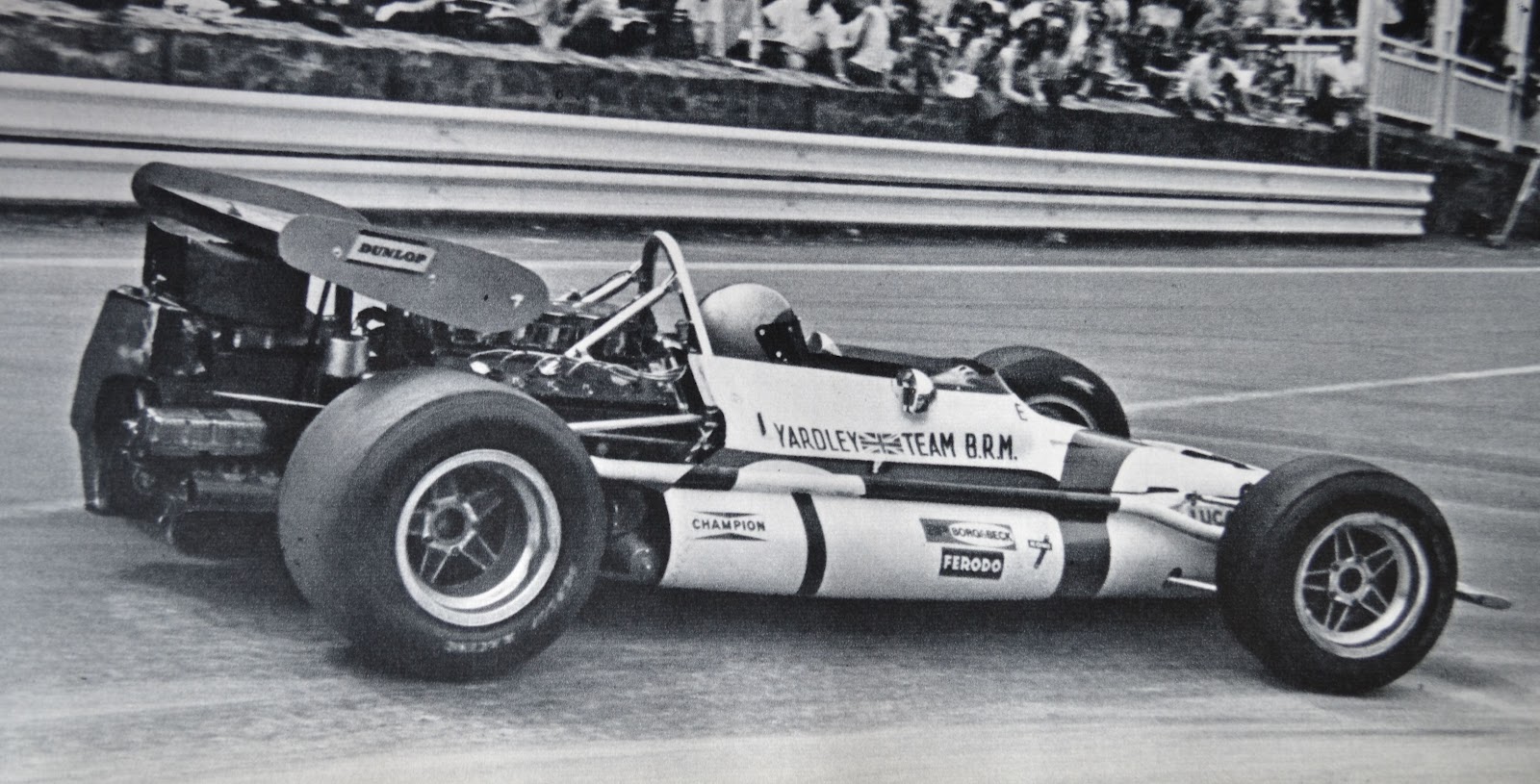
The BRM of Pedro Rodriguez

The race wore on but the pace never dropped. The two leaders were never more than 3 seconds apart and simply left the rest behind. Amon took his March to a new lap record – an average of over 245km/h (152mph) – but it still wasn’t enough. At the finish, Pedro was just over one second ahead.

The Amon luck had struck again. The BRM was not to feature in a race again in 1970 and at the one circuit which puts the most strain on a car and engine, it had held together to yet again deny Chris of his maiden GP victory. He would never again come so close.

But it wasn’t all despair.


Fabulous Michael Turner painting of the 1970 Belgian
Grand Prix
‘I flew back to England soon after the race and that night a bunch of us went out to a bistro in London. I remember sitting there and thinking how unreal it all was. Had it really been that afternoon I had run Spa at the absolute limit? That was the thing about Spa….if you were satisfied with your driving there, it gave you a high for days. No other track did that.’

Thanks to Jackie Stewart, the old Spa was erased from the calendar, perhaps rightly. But it would return, in modified form, to once again become the drivers’ favourite.