IF ITS GOT WHEELS AND AN ENGINE, IT'S HERE

Thursday, 6 October 2011

Speed vs. Revenue

Speed 3 - The Final Insult

It’s very interesting that, just at the moment the South African government are proposing to reduce speed limits on the highways to reduce the road death levels, the UK government is debating whether to raise their motorway speed limits from 70mph to 80mph (117km/h to 133 km/h).
This just brings into sharp focus the utter stupidity of those in charge of our roads and the legislation that governs them. What baffles me is that they seem to be completely ignorant of the basic facts that even the most uninterested citizen acknowledges to be common sense.
Speed in itself does not kill. Speed in the wrong place kills. Atrocious levels of driving skill kills. Ignorance and arrogance on the roads kill. Corruption in testing stations and penny-pinching by private and commercial owners kills.
But to claim that lowering the highway speed limit by 20kmh will make any difference to the road death toll is pathetic. A bus or taxi full to the brim but with defective brakes or shock absorbers will have an appalling accident whether it is travelling at 120km/h or 80km/h. When there is that much metal and that much momentum, it is never going to be a mere bumper bashing. And it is these vehicles that are responsible for the greater proportion of road deaths.
 It is yet another example of the government side-stepping the issue of the condition of the majority of vehicles involved in the crashes in the first place. It is almost a case of; we can’t start pulling all the un-roadworthy vehicles off the road or imposing stringent and enforced levels of roadworthy-ness because half the vehicles on the roads would disappear and the larger proportion of the population will have no transport at all. So let’s rather lower the bar to their vehicle’s level and everything will be alright.
How many times have you been in traffic on a highway behind an old scrap heap of a car with, for example, absolutely no lights whatsoever – and I don’t mean just not working, but physically no light unit or ones that are absolutely smashed – or moving crab-like along the road whilst travelling forward and in the lane next to you is a police car with unrestricted view of the – patently – un-roadworthy vehicle. Does the policeman pull him over and with a look of disbelief tell him to walk home as his car is going to be towed to the scrap heap?
No, he ignores it and instead pulls over Mr Wealthy in his Range Rover. Before you accuse me of exaggeration, I actually saw this happen on the M1 near the Corlett Drive exit. I am not about to get into the whole dung heap argument of police bribery and corruption but I think the principle is the same; penalise the ones who can afford it and leave the rest of them to endanger lives.
The situation is almost becoming farcical; we will be told to travel slower on highways that our tax money paid for to be improved which we now have to pay to use! But still the risk of death will be there because the mobile death-traps will be all around us.
Talk about addressing the wrong issue. But what do we, the motorists, do? Nothing! We sit and take it and complain and take some more and still complain and continue to get shafted. Will we do anything about it? Not a chance. That would involve standing up to be counted and I’m afraid modern man is just too much of a wimp to do that.
So the powers that be will carry on and try to introduce legislation that will only serve to fill their coffers, none of which money will find its way back into the road system that generated it in the first place. One can only hope that sense will prevail, but given our beloved leaders priorities, I’m not so sure that will be possible.

1957 German Grand Prix

Fangio’s Master Class


Michael Turner's painting shows us the moment when Fangio, half
on the verge, scrabbled past Collins and set off in pursuit of Hawthorne. 

 Formula One in the fifties belonged to one man; Juan Manuel Fangio. Five World Championships and victory in nearly 50% of the Grands Prix he entered – 24 out of 51 – ensured that he remained the man to beat; he was the yardstick by which every other driver on the grid was - and, to some extent, still is - measured. Without exception he is on every ‘Greatest Drivers of All Time’ list, invariably at number one.
He was a sportsman of impeccable integrity and honour. Was it by chance that both Kling and Moss won their home Grand Prix whilst team mates to the great man, in seasons where he had the measure of them both and more? And if he did gift the races to his team-mates, he was humble enough never to admit it, merely saying that the best man won on the day.
But mostly, he was an artist. His driving was an object lesson in car control and speed; always precise; always clean but giving no quarter in a fight.  For 1955, Stirling Moss, having proved his worth in a private Maserati 250F in ’54, was invited to partner Fangio in the Mercedes team and was happy to follow in the master’s wheel tracks; so closely did Moss follow the Maestro in Grands Prix that they were dubbed ‘the train.’
This, understandably, worried the Mercedes team management; if Fangio were to make a mistake and crash, there was no possible way Moss could avoid him and both cars could be lost, let alone both drivers. Moss placated his employers with the devastating logic; ‘Juan Manuel simply does not make mistakes.’
It was Fangio’s willingness to have a team-mate who was capable of beating him that underlined his greatness. For Moss was no second string driver and had the edge over Fangio in Sports Cars as much as Fangio was the undisputed master in open wheelers.
But any edge you had over Fangio was always a tenuous thread. Whilst  Moss’ victory in the 1955 Mille Miglia has passed into motor-racing folklore - he drove the Mercedes 300SLR to victory in record time with Denis Jenkinson by his side reading pace-notes to ease the strain on Moss of remembering 1000 miles of public roads - it is often forgotten that Fangio came second in that race driving solo! At the flag, and after suffering from fuel injection problems, he was only 32 minutes behind after ten hours!
Throughout Fangio’s F1 career, he drove for the Alfa Romeo, Ferrari, Lancia, Mercedes and Maserati teams, winning championships in ’51, ’54, ’55, ’56 and ’57. If we are to be precise, however, the Lancia he drove to the 1957 Championship was badged Lancia-Ferrari, as Lancia, finding the cost of competing in Formula 1 simply too expensive, had made a gift of their entire racing team to Ferrari who ran the modified cars as his own.
For 1957, his last full season of racing, Fangio was driving for Maserati, who were fielding the glorious 250F. Whilst the Mercedes had been Teutonic and effective, but never beautiful in the traditional sense and the Lancia-Ferrari twitchy and difficult, the Maserati, on the other hand, was pure Italian artistry, in both appearance and manners on the race track and no less effective for all that. Fangio loved the car; ‘Aye…the 250F. Not very powerful, I recall, but beautifully balanced. A lovely car to drive. I felt I could do anything with it.’
The mighty, daunting, Nurburgring was the setting for the 1957 German Grand Prix. Fangio went into the race needing a win to clinch his fifth World Driver’s Championship. Against him were the Ferrari’s of Hawthorn, Collins, Musso and von Trips, the Vanwalls of Moss, Brooks and Lewis Evans and his own team mates Behra and Schell. The fact of the matter was that the Maserati was no match for his rival’s cars, but they didn’t have Fangio at the wheel.
He doesn't really look as if he's trying, but by the end of the
race he will have knocked 26 seconds of his lap record of the
previous year!
Ever the tactician, Fangio decided to start on half-tanks, to allow himself to build enough of a lead so he could stop at half distance to refuel and maintain the lead.
In those days, as it remains today, the Nurburgring was 14 miles long and comprised 170-odd corners. Bear in mind, however, that there existed none of the Armco protection or run-off areas that blight circuits – even the Nurburgring itself - of the modern era. If you were lucky, there was a hedge lining the track to stop you if the car broke or you made a mistake. If you weren’t lucky, there was a 50 metre drop behind the hedge!
In Fangio’s time, a lap took around 9 minutes 40 seconds, and there were 22 of them for the race. If that seems slow by today’s standard where ‘ordinary’ road cars are lapping sub 7 minutes 30 seconds then consider the technology extant in those times; drum brakes, flexible chassis, super-skinny, rock hard tyres, rudimentary suspension, no seat-belts and a tortoise shell for a helmet. Ask any current GP ‘Superstar’ to emulate the feats of their predecessors and they will look at you as if you were mad.
But I digress. On the third lap, Fangio took the lead from Hawthorn and started to pull away. By lap ten, he had a lead of 30 seconds. On lap twelve he stopped for fuel and tyres, the plan working perfectly.  
Then; disaster! The pit stop was desperately slow and Fangio lost not only his 30 second lead but a further 20 seconds to Hawthorn and Collins. Ten laps remained.
Collins, with no clutch left, was powerless to resist
Fangio's pressure
He set off in pursuit and for three laps nothing happened - the gap to the leaders remained the same. Then the timekeepers started to double-check their stopwatches; Fangio was lapping a full 15 seconds under the old lap record, set the previous year, by himself, of course! This was impossible! But that was the magic of Fangio; he made the impossible happen occasionally.
By lap 19, the gap was 13 seconds, by the end of lap 20 he was right with the Ferraris. Collins, with his clutch gone, could do nothing to hold the ‘old man’ at bay and, in a shower of stones kicked up from the verge by his rear tyres, Fangio got past in a long, perfectly controlled slide. Hawthorn gave it his all, but could not prevent the inevitable; it was the quiet Argentine at his most ruthless.
At the flag, Fangio was 4 seconds ahead. He had driven as no man had driven before and you could see it in his face as he pulled into the pits to receive the plaudits. He later admitted that he never wanted to drive that hard ever again; he admitted to taking every corner a gear higher than he had done in practice and qualifying.
There was simply nothing Hawthorne could do to keep
Fangio at bay; he was passed with 3 laps to go. 
Only he could know what risks he took out on the track in his pursuit of the Ferraris and the thought of it scared him silly!
Many years later in an interview, he said, ‘Even now….I feel fear when I think of that race. Only I knew what I had done, the chances I had taken.’
His fastest lap for the race was 9 minutes 17 seconds. In modern Formula 1 we are used to a lap time decrease year on year of maybe a second, if we are lucky. Fangio’s improvement of his previous year’s fastest lap was a staggering 26 seconds, in a car which had barely changed during the same period.  
It was to be his last Grand Prix victory; he would retire, reputation intact, after the French Grand Prix at Rheims the following year.
He was gone but would never be forgotten.

Great Bikes?

No 1. The MGC, France, 1935


MGC N3BR. 1932. 250cc


We take aluminium very much for granted these days and cast aluminum components of a motorbike chassis are nothing unusual; any number of bikes have them. But it was not always so.
Aluminium was widely adopted in industry – particularly by motor and motorcycle manufacturers - after WW1 for its light weight, good heat conductivity and shine. However, it lacks, especially in cast form, steel’s ability to resist vibration fatigue. It would take years of foundry progress before cast aluminium could be widely used in motorbike chassis and an equally long time before engine refinement reduced vibration to an acceptable level to make use of the material a viable proposition.
The principal casting comprising the tank, top frame member and headstock.
Marcel Guiguet was a French motorcycle dealer who became obsessed with the idea of casting as a single piece many of the previously separate structural and functional frame components of a motorcycle. His idea was to enclose the engine between an upper member comprising the tank, headstock and chassis beam and lower member which comprised the oil tank and the lower frame structure extending back to the rear wheel, the two joined by vertical aluminium struts.
Showing the various pieces of the puzzle. As well as
 the main tank structure, all other components were
also cast from aluminium. 
The early castings were porous and prone to cracking from shrinkage – no-one had attempted large hollow, thin-walled castings before. His material of choice was a high silicone alloy called Alpax, and he eventually cured the porosity with heat treatment and drying oils. The parts were still prone to cracking in use, however and, even when current, the survival rate of machines was low; the skill to weld aluminium successfully without distorting the structure simply did not exist in the workshops of the day.
Production began in 1929, the machine called the MGC – Marcel Guiguet & Co.
Proprietary and familiar engines - mainly the British JAP 500c single – were used so at the 1928 Paris Salon all eyes were on the revolutionary chassis.  
Nothing like it had been seen before and it generated great interest but the bike was a financial flop – it was simply too expensive to produce and only around 200 were made and that was the end of MGC.

Exceptionally narrow frontal aspect
He had started something, though. But the world had to wait more than 50 years for the MGC frame concept to become viable through increased knowledge and techniques with aluminium and it was the 1985 Suzuki GSX R 750 that heralded the true dawn of the age of extruded and cast aluminium beam-framed bikes. 


This article first appeared in www.iauto.co.za

Bloodhound SSC - To 1000mph and Beyond

Land Speed Record Comes To Town


Computer generated image of the Bloodhound SSC.
It is very possible that the last roll of the Land Speed Record dice is to happen in our lifetime. Once the Bloodhound SSC project has reached (or not, as the case may be) its target of 1000mph it is unlikely that the laws of physics will permit any further increases. Not only that, but after that figure has been reached, what would be the next meaningful and, more importantly, achievable milestone? Surely an incremental advance, such as happened in the thirties, would hold little appeal for backers and public alike.

Richard Noble and Andy Green have annexed the record for the last 28 years, first with Noble’s 633mph and later with Andy Green’s breaking of the sound barrier on land at 763mph. In between those attempts were pretenders to the crown; nor were they without serious credentials. Names such as Breedlove, McGlashan and McLaren International all provided the necessary spur to Noble and his team to reach for the sound barrier. That they succeeded again where the others failed was testament to the British team’s tenacity and skill.

Aussie Invader 5R
Now, Bloodhound is set to push the record out of reach for all time; if it can get there first, that is. Once again the global contenders are assembling for this one last desperate attempt at the ultimate motoring goal. From Australia there is the indefatigable Roscoe McGlashan and the Aussie Invader 5R and from America is the American Eagle. With the nature of the challenge comes immense danger as new regions of speed are explored. Because of this, no-one is going to go straight out and try for 1000mph. Each of the teams will build up to their maximum in a series of carefully planned runs over a couple of years.

The North American Eagle. 
Thus we should see a return to the golden eras of record breaking when the record shuttled back and forth between two or more players over a short period of time; Campbell and Segrave; Cobb and Eyston; Breedlove, Arfons and Gabelich.

Critics of the LSR have been many through the years, questioning the point of the exercise. Many are the times when the answer has been, like Everest; because it’s there to be beaten. But this time, it is not enough to do it because it is there. Record breaking costs huge money and that money doesn’t grow on trees. Sponsors have to invest in possibly the most uncertain project of all; success is not guaranteed and sponsors need to see a return on their investment. Failure does not necessarily constitute that return.

So this time Noble has addressed a serious issue. There is possibly not a country in the world that is lacking in essential skills in its workforce. His last two record attempts have highlighted the dire need for engineering expertise to be nurtured and developed. With Bloodhound, he has called it an Engineering Adventure and made the bedrock of the project to involve schools, colleges and universities in an attempt to share the excitement and foster an interest in engineering at grass-roots level. This way companies can see the real, long-term benefit of supporting the project.

It is possible, however, in an age obsessed and satiated with speed, that the excitement and wonder generated by such a feat of engineering may prompt stifled yawns among the very people it is hoped will be inspired.
     
But the fact remains that the margin by which Bloodhound will surpass even the most astoundingly fast road car of modern times is still the same margin that Segrave or Campbell surpassed performance cars of their era. Today, a Bugatti Veyron will travel faster with an 8-litre engine than Malcolm Campbell managed in 1931with a 26.9-litre engine and he didn’t get to run to the shops in his car! But Campbell’s 246mph was just as out-of-this-world to motorists of his day, when even 70mph in a road car was an achievement.


So why should we in South Africa get excited? Because this (potentially) last chapter in a century-plus-long obsession with ultimate speed is to happen right here on South African soil. Well, desert actually; a remote part of the Northern Cape called Hakskeen Pan has been selected as the prime location by the Bloodhound team. Nearly 80 years after Malcolm Campbell chose Verneuk Pan as the venue for a record attempt, South Africa is once again on the LSR map. And this one is going to be the daddy of them all. 

This Week I Have Been Mostly Driving...

2012 JAGUAR XF 2.2 DIESEL

With the introduction of the XF 2.2 Diesel Jaguar might want to appear to be listening to the environmental lobby and certainly they make a big deal of the 5.5l/100km consumption, as indeed they should for this class of car, but the reality is that the move is more in response to the money men at Tata who, of course, now hold the purse strings at Jaguar.
Currently with no model in the sub-R500k bracket, Jaguar is losing sales to direct competitors Audi and BMW. To compete, they have to abandon one of their core attributes and stoop ever lower in the performance stakes to keep up with the Joneses. Or the Schmidts, in this case.  
So does it work? Well, yes and no. Whilst acknowledging the reasoning behind why the XF2.2 exists I can’t help feeling that Jaguar are building down to a market rather than up to a standard that has traditionally been high.
Having gone to great lengths in recent years to shed the ‘old man’s car’ image they have now gone out of their way to build another. The performance will not frighten anyone over the age of 60 and the running costs will appeal to their sense of thrift.
Despite the 140kw and 450nm the XF2.2 feels sluggish off the line. What is of more concern is the lack of in-gear overtaking punch which is surprising for a turbo diesel. It is possibly this lack of oomph that will backfire for Jaguar. Hoping to attract a younger, less wealthy buyer will not alter the fact that that buyer goes for Jaguar for the performance image as much as the physical appearance.
The absolute refinement of engine, drivetrain and chassis might contribute to the disappointment in the performance. If there is one area where Jaguar has consistently excelled and continues to do so, it is in isolating the occupants from engine noise and general vibration. There is simply no indication from inside the car that you are in a diesel or that you might be travelling rapidly, no matter how long it took you to get there.

100km/h comes up in 8.5 seconds, but the manner it achieves this is so devoid of any fuss or drama, or noise for that matter, that it is easy to underestimate your road speed. Get your heart racing it will not, however, and, if you use the 8-speed auto ‘box to the redline in every gear in order to wring some performance out of it, you won’t see the consumption figures Jaguar claim. Still, less than 10l/100km over 300 hard-driven kilometres is nothing to be sniffed at.
Whatever the drop-off in performance from the 2.2 diesel, what is not diminished is the cachet of owning a Jaguar and the fact that you have the best looking sedan on the road, which subtle styling manipulations have further enhanced for the 2012 model year. In short these equate to new styling forward of the A-pillar, with new, sleeker headlights which give the car a meaner look, not entirely dissimilar to the A4 Audi. But driving a Jaguar on the road gives you a feeling that no A4, or its direct rival, the A6, could ever give. It might not be perfect in this engine guise but at the end of every journey you can still step out of it and look back and wonder at its beauty.
Jaguar need to attack different markets in order to ensure survival. However, it will take a mind-shift in the eyes of potential customers to accept the new frugal face of Jaguar. And the change in perception will not limit itself solely to economy. In the pipeline are new vehicles targeting new (for Jaguar) market sectors. First off, there is a convertible sports car to compete with the Mercedes SLK and BMW Z4, followed by a medium-sized sedan to go head-to-head with the BMW 3-Series and A4 Audi. Both will be brave gambles, taking on as they will be the established market leaders, but if anyone can do it, Jaguar can.

That's the gear you're in, not the track that's playing
on the CD!

1969 Le Mans 24 Hours

A Walk in the Park


Let’s face it; 24-hour races can be very dull! Yet, at the end of this year’s running of the Le Mans 24 hours, we watched the first and second placed cars fighting it out right to the line, a mere 13 seconds separating them at the flag. But there has been a closer, more exciting finish.
The Porsche 917. Brand new and VERY scary. In this early form it
wanted to fly and claimed the life of privateer John Woolfe on the
first lap. This is Vic Elford who led the race for many hours before being forced
out with mechanical problems
The late sixties were golden years for sports car racing. Ford, stung by Ferrari’s last minute refusal to sell his company, decided to beat him at his own game and developed the GT40 from the British Lola GT concept and, after a couple of false starts, won the race in ’66, ’67 and ’68, soundly beating Ferrari each time.
By 1969 the GT40 was becoming a bit long in the tooth - albeit a still healthy tooth - and Porsche were snapping at Ford’s heels. Long successful in endurance racing, Porsche had nonetheless failed to win Le Mans outright and they put into effect a plan to do just that. Thus was born the awesome 917, which in its early long-tailed form was as lethal as it was blindingly fast. It was still very new, however, so Porsche hedged their bets by entering several of their older, eight-cylinder 908s.  
The start and Ickx walks nonchalantly across the track to his waiting
GT40, the rest of the pack already at their cars
The traditional Le Mans run-and-jump start was still in use in ’69. Safety in motor racing was starting to be an issue in the late sixties and seat belts were a new development; opinions about them were divided and many drivers considered it a waste of valuable seconds to do them up before moving off, if they were fitted at all.
As the flag dropped, the drivers sprinted across the track to their waiting cars. All except Jacky Ickx. As a protest against the regulations he strolled casually across the track, climbed into his GT40 and fastened his seat belts before he got going, dead last.

The first Porsche to retire was the 908 of Siffert/Redman with gearbox trouble
During qualifying the Porches had been devastatingly quick, pulverising the lap record, despite speed-limiting changes to the track since the previous year. In the race it was the same story; the Porsches streaked away at the front, running 1, 2, 3; the 917 of Elford and Attwood leading. The Fords rumbled around behind them waiting for the Porsches to break – not that they broke very often. But this time was different.
At the end of 24 hours' racing, this is what it came down to
By 7am Ickx was up to third, 5 laps down on the leading 917. By 9am, the leading Porsche was into the pits for attention to the front end but still had a 4-lap cushion. 40 minutes later it came in again, this time for attention to the back end and was sent out still in the lead but now sounding rough. The Fords were waiting to pounce.
With four hours to go there was but one Porsche left – all the others out with mechanical trouble, including the leading 917. The 3-litre 908 of Hans Herrmann was second behind the 5-litre Ford of Ickx/Oliver! But, if it was thought that the race was over, with cars needing to be nursed to the finish, then it was clear the drivers hadn’t read the script!

For the next three and a half hours, the leading Ford and Porsche went at it as if they were at the beginning of a Grand Prix and not at the end of a gruelling 24-hour, car-breaking race. As one car pitted for fuel and tyres, the other would take the lead, only to lose it again as it too, pitted.
Into the last hour they raced, never starting a new lap with the same car leading. It was hammer and tongs stuff, Porsche desperate to win for the first time, Ford trying for one last victory for its aging battleaxe. The Porsche was down on power, the Ford having to watch its fuel.
It still wasn’t settled as they entered the last lap; the two drivers swapping the lead at least twice as they thundered round to the finish line. On the pit straight, necks craned to see who would emerge out of the final chicane first. It was Ickx and he crossed the line 20 metres ahead of Herrmann in the Porsche. After 5,000kms of racing!
For Ford it was the end of an era, for Porsche it was just the beginning.


To the victor the spoils


Herrmann can only sit and ponder what might
have been, alone as the winners celebrate


This article first appeared in www.iauto.co.za online magazine

The Man Called Mike

Isle of Man, 1978 and 1979 - Comeback and Farewell of a Legend

Mike Hailwood at the 1978 Isle Of Man TT

Imagine this; the greatest bike racer of his generation – some would say all time - has been retired from 2-wheeled racing for 11 years. He stopped at the peak of his profession and went car racing instead. He didn’t do too badly, either. Then a bad accident at the Nurburgring in his Yardley McLaren crushed his right foot and that was the end of his racing career.

Hailwood as he was in the sixties, riding the 250cc, 6-cylinder Honda
Four years later rumours start to circulate that he is going to make a comeback at the greatest, most difficult, most deadly circuit there is; The Isle of Man TT. The rumours turn out to be true. He does come back. And he wins; beats some of his old adversaries and all the new bloods who have assumed his mantle in the intervening years.
To prove it wasn’t a fluke, he comes back again the following year – without having ridden competitively in the interim – and wins again. This could only be the story of one man; Mike Hailwood.
At the end of the 1967 season, Honda, for whom Hailwood was riding, announced their decision to pull out of competition; they had achieved all their goals, won everything. They paid Hailwood to not ride for any other manufacturer and thus drew the curtain on a stunning career; 9 world championships and 12 TT wins across all capacities.
With the bike world closed to him he turned to four wheels. He was good, too; in Formula 1, Sports Cars, and Formula 2. Then came the accident at the Nurburgring in ’74 which smashed his right foot and ankle and that was it.
He retired first to South Africa and then further south to New Zealand. But living in New Zealand bored him to tears, and when that happens to a man, he starts dwelling on times past and unfinished business. And so the seed of a mad idea started germinating in his mind. He was still fit, young – only 38 – and possessed of a desire get back to what he did best. There was only one place to do this; the Isle of Man, where the legend had been built all those years ago.
 By 1976, the Isle of Man TT was gasping for air. Top GP riders, such as Agostini and Sheene, had boycotted the race due to the danger involved. Somehow it never seemed fair that a win at the Isle of Man earned the same points as a win at some of the more antiseptic circuits on the calendar.
This was the time when riders were making their voices heard about track safety and the FIM finally revoked the TT’s World Championship status, leaving it a shell of its former self. The organizers were quick to realise that the re-appearance of Hailwood would be the lifeline they sorely needed and lost no time in agreeing terms for his return.


Mike at the official launch and announcement of his comeback, posing on the 350 Yamaha.

With a minimum of fuss, wheels were set in motion. Bikes had to be found as a matter of first importance. The year before, 1977, a Ducati 900cc twin had come within a whisker of winning the Formula 1 event, entered by a small Manchester bike shop called Sports Motor Cycles. They were denied victory only by the poor timing of a decision by race stewards to halt the race following torrential rain. When the race was stopped Roger Nicholls, on the big Ducati, had already made his pit stop whereas Phil Read on the Honda had yet to stop so consequently was ahead as the flag fell.
Cautiously, Sports Motor Cycles were approached; would they be interested in providing a bike for Hailwood? You bet they would and it would be the best decision they ever made. Yamaha were also approached and agreed to supply a 350cc, a GP 500cc two-stroke and a fearsome OW31 – the TZ750 two-stroke.
News of Hailwood’s comeback spread like wildfire and record crowds made their way to the Island for TT week. Hailwood’s appearance had already paid off, no matter how he did in the races.
But, whilst there were those who knew he could still do it and would win, there were just as many who feared that he was going to make a fool of himself. The bikes had changed out of all recognition since he last raced; the power they developed; the handling; massive advances in tyres and brakes. Even the circuit had changed. He might as well have been riding on another planet.
Until official practice on the Island, no-one, except perhaps Mike himself, knew if he could pick up where he left off – winning. ‘If he finishes any higher than fifth in any of the races against the current lot of TT riders, I’ll be very surprised,’ said Steve Parrish, Barry Sheene’s team mate at Suzuki. Tommy Rob, one of Mike’s old adversaries, had a different view; ‘He’ll go well, I’ve no doubt. And I fancy him to take the Formula One race on the Ducati.’
After the first practice sessions all doubts were dispelled and his rivals knew they were up against it. On the 500cc Yamaha he broke the official standing start record by nearly a second; on the Ducati he lapped nearly two seconds faster than main rivals Tom Herron and Phil Read, both on Hondas. Neither rider felt they could go any faster without sticking their necks out further than they wanted. It was almost as if he had the race won there and then.
For one practice lap, Mike pushed off the line in company with Mick Grant, holder of the lap record and favourite to take the Classic on the 750 Kawasaki. Grant was following closely in Mike’s wheeltracks when, approaching the sharp right at Ballacraine, Mike suddenly sat up and grabbed the brake a good thirty yards before he needed to. Grant was so surprised he nearly rammed him. Something must be wrong, thought Grant, but it happened again and again; ‘It took me some time to realise that he had no idea of braking points,’ said Grant later. ‘He was riding as if the machine still had drum brakes, and here we were on the most sophisticated discs, the best stoppers you could get.
‘It suddenly dawned on me just how good his riding had been all week if his braking was so bad…..I couldn’t get over how he had got round so quickly….on machinery worlds apart from that which he used to ride. All of it underlined to me just what a genius of a rider he was.’
TT week involves several races across all capacities; the Senior for bikes of 500cc – Grand Prix class; the Formula One race for bikes up to 1000cc; the Classic, which is a free for all plus several smaller capacity and sidecar races. The Formula One race was first on the agenda and was the setting for one of the best races in TT history.


The one and only Mike Hailwood on his way to winning the Formula 1 race at the 1978 IoM TT


A TT race is not like a short circuit race. Riders set off in pairs at 10 second intervals and race against the clock, not side by side on the track. Mike was due to set off 12th, with main rival and reigning Champion Read, on the factory Honda, setting off first, 50 seconds ahead. Immediately, it was obvious that Read couldn’t match his practice pace, but Herron, on a privately entered Honda was looking threatening. Hailwood played himself in gently, but not too gently; he was the fastest man on the track from lap one! Then, as they crossed the start/finish line for the second time, the news everyone yearned for came from the timekeepers; Mike was 9 seconds ahead of Read, albeit 41 seconds behind him on the road.
By now, Hailwood was flying and at Ramsey, halfway round the third lap, the crowd got what they wanted; Read and Hailwood within yards of each other. Read had no idea Mike was so close, but when he saw the crowd at Parliament Square erupting in mad delight, he knew it could only be one man.
‘To say I was surprised when he caught up with me,’ said Phil, ‘is putting it mildly.’
Mike’s comment was; ‘It was lovely to see him just ahead of me…I followed him uphill out of Ramsey towards the mountain. We passed and re-passed each other [but] I wasn’t too bothered about rubbing it in or trying to get away too far.’
He had no need to. He was now effectively 50 seconds ahead of Read and, although Tom Herron had closed to within 4 seconds of Hailwood, he was out on the next lap with mechanical troubles. The race was Mike’s unless the bike let him down.
‘I couldn’t see anything to stop him,’ said Read. ‘I could not have gone any quicker…I was right on my limit and there was nothing, not a mile an hour more, left.’ The only way to stop Mike was to try and break him. In a last desperate bid to force the Ducati to go faster than it wanted, Read sent the tacho needle of the Honda way past the red-line and dragged a burst of speed out of it that it was not designed to give. An oil seal blew and the bike clanked to a halt, spewing oil and blue smoke. Hailwood was too old a campaigner to fall for Read’s tricks and went serenely on his way. He crossed the line 2 minutes ahead of second placed man, John Williams.
‘[That last lap] was by far the longest lap I’ve ever known at the TT,’ said Hailwood afterwards, ‘I couldn’t wait for it to end…as I got closer to the chequered flag the tears started to stream down my face. I was so full up with the emotion of it all… I couldn’t help myself….I’ve had some wins, here and in the rest of the world, but for sheer emotion this beats them all.’
Not one of his rivals begrudged him the victory; all were magnanimous in defeat; ‘It’s a pleasure to be beaten by a man like that,’ shouted John Williams, stepping up onto the podium. Phil Read; ‘He deserves it; there was nothing lucky about it. Even if I’d kept going there was no way I’d have got away from him.’
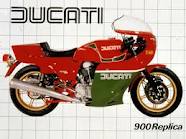
Ducati capitalised on the victory and honoured
 Hailwood with the 900SS MHR Replica
After the excitement and emotion of the Formula 1 race, the Senior was an anticlimax. At Mike’s suggestion, the mechanics had fitted the steering damper from the big Yamaha 750 onto the 500, convinced it would help the handling. Running fourth on lap two, the damper seized and he could only trundle back to the pits, falling two minutes behind the leaders in the process. He rejoined, but ran out of fuel on the last lap, eventually finishing 28th. 
He had achieved more than anyone dared hope and repaid all the faith shown in him, but still the failures rankled (the big Yamaha had broken in the Classic just as the predicted battle with Mick Grant on the Kawasaki was heating up) and it didn’t take Mike long to determine to return in 1979.
Ducati were again keen to supply a bike but Yamaha, asked for a current 500cc machine, said no, stating that they felt their machinery would not be equal to the talent of Hailwood. As Kenny Roberts had just clinched the ’78 World Championship on one, it was hard to follow their reasoning, but they were not to be moved.
Where Yamaha feared to tread, however, Suzuki were only too happy to be given the chance and a 500cc GP machine was made available.
It was clear that development of the Ducati had not only been non-existent, but the bike had actually regressed – it was slower and just could not be made to handle; it was a real dog and not a machine that Mike relished riding to try and repeat last year’s triumph in the Formula One race. The build-up didn’t go well; testing the Ducati in Italy, the bike spat him off, Mike breaking several ribs. By contrast, after testing the Suzuki at Donington, he told the mechanics to put it away and leave it alone – it was perfect.
If 1978 had been the comeback, then 1979 was the farewell. After the emotion of ’78, 1979 promised to exceed all expectations as Hailwood again stepped forward to do battle with the Island. This time, people knew he could win and he was taken all the more seriously; not that he had been underestimated the year before but, this time, the novelty and uncertainty had gone and he was seen as a very real threat.
Hailwood was really up against it for the Formula One race and could only manage fourth fastest time in practice with Scotsman Alex George breaking Mike’s lap record of the year before, claiming he hadn’t pushed himself or the Honda to their limits.
In the race it was all George. There was nothing Mike could do but, typically, gave it everything he had, even on a bike as bad as the Ducati was.  On the last lap his battery box came adrift and, despite stopping out on the circuit to fix it, he still came in fifth. ‘Well, that’s one to forget,’ he said after the race. ‘I’m bloody glad it’s behind me. I tried as hard as I could, but it was pointless.’
His best lap at 109.39 mph might not have set the world alight – George’s best was 112.45 – but it moved one insider to comment; ‘That must have been one of his finest laps of the TT. On that Ducati, handling as bad as it was, and being so way behind in power, it was an heroic performance. I just don’t know how he did it.’
Prospects for the Senior were much brighter, as he would be riding the Suzuki. However, things were about to get a bit tense! On a late visit the night before the race to the mechanics, who were still working in the garage underneath the hotel, he was dismayed to find the engine on the workbench in a thousand pieces. When they had started the engine that afternoon, great plumes of smoke came out of the exhaust – it was burning oil at a huge rate and wouldn’t have lasted a lap. There was nothing for it but to strip it down. It took them all night to find the problem – a coil spring had flicked off an oil seal - and when the bike went to the line the next day, it had not turned a wheel in anger since they had finished, although they had entertained the guests by starting it up at 5 in the morning to see if it was still burning oil.
At the end of the first lap Mike was third, behind Grant and George. But then Grant retired with a broken crank, and Mike simply blitzed the rest of the field, raising the class lap record to 114.02mph in the process. It may not have been as emotional a win as ‘78’s Formula One but, as a demonstration of skill, it left his rivals floundering and wondering why he ever retired in the first place. It was his 14th TT victory.
The Classic that rounded off the week was just that. It was a straight fight between Hailwood and George and both men dug deep and performed miracles, riding as hard as they knew how. Mike knew what the Suzuki was capable of, but George’s Honda had 500cc’s more and was fantastically fast.
They set off, Hailwood first and George 15 seconds later. Despite being so close on the road, they were not to see each other again until the end of the race, so evenly were they matched. George eased ahead by a few seconds, but could not make the break stick. They both rode faster and faster. On the penultimate lap, Mike put the hammer down and clawed back to lead by one second. Alex put everything into his last lap, clipping banks, running wide, wringing every last ounce of speed from the Honda. Mike had appalling luck with back markers who put him off line and delayed him. At the line he was but 3.4 seconds adrift.
He was gutted; ‘…I tried so hard. I was sticking my neck out all over the place, far more than I wanted to. …I wouldn’t want to go through a last lap like that one all over again.’ By the time he got to Alex on the podium, the disappointment had been replaced with praise and admiration for what his rival had achieved. The curtain had come down on the career of a TT legend but still his first thought was to give the winner his due and say nothing about himself.
Never comfortable with praise himself, Mike would always try and find a way around any compliment. Vernon Cooper, the man responsible for setting up the deal for Mike to return to the TT, emphasized the value of having Mike there. ‘When we shook hands on Mike’s comeback, it was probably the most important symbolic gesture in the long history of the races,’ he said.
Mike could only reply; ‘Well, it did me a favour, too. I got a second place; I’ve never had one of those on the Island before.’